
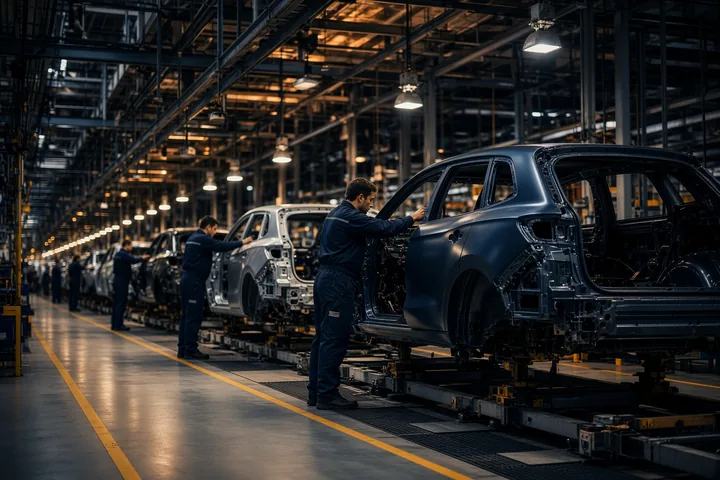
Across the Middle East and North Africa, governments want vehicles built locally, and vehicle brands, many of them Chinese, are answering. Morocco has become a major exporter. Egypt, Algeria and Saudi Arabia are building plants. Oman has its first projects. This article sets out the stages of an assembly project, from the first feasibility question to the first vehicle off the line, and what the region’s recent plants teach.
The regional picture
- Morocco. Renault built 394,474 vehicles in 2025 at Tangier and at SOMACA in Casablanca, exported 82% of them, and has a local integration rate of 65.5%, excluding mechanical components. Stellantis’s Kenitra plant, opened in 2019, is being extended by EUR300m to a capacity of about 535,000 vehicles a year.
- Egypt. Geely has opened two assembly lines (up to USD100m, up to 10,000 vehicles a year). Al Mansour Automotive broke ground in November 2025 on a USD150m MG plant with SAIC Motor, for 50,000 vehicles a year in its first phase and 100,000 within five years, with production due in the third quarter of 2026. Kasrawy plans a plant in Sixth of October City to assemble Jetour and JAC models. The national programme sets minimum volumes of more than 10,000 vehicles a year per manufacturer.
- Algeria. Fiat has built vehicles near Oran since December 2023. Hyundai, with Oman’s Saud Bahwan Group, plans a USD400m CKD plant in Relizane for 50,000 vehicles a year, with production expected in late 2026 or early 2027. Chery said in April 2026 that its project had all the required licences and that production of four Tiggo models was close.
- Saudi Arabia. Hyundai and the Public Investment Fund are building a CKD plant at King Abdullah Economic City: about USD500m, 50,000 vehicles a year, with production targeted for the fourth quarter of 2026.
- Oman.
- Karwa Motors at Duqm Special Economic Zone, 70% owned by Qatar’s Mowasalat and 30% by the Oman Investment Authority, rolled out its first bus in November 2021. It delivered about 900 vehicles in 2025, and in October 2025 became an approved builder for Daimler Buses.
- Spruce, a Chinese company, signed an agreement in May 2026 with Khazaen Economic City for a plant to assemble electric and hybrid vehicles and parts: a RO5m first phase of a RO20m project, for more than 3,000 vehicles a year.
- JCI (Jiangsu Changhong Intelligent), also from China, signed an agreement in November 2025 with Salalah Global City Company for an automotive factory in the free zone next to Salalah port.
Two patterns stand out. Most projects pair a vehicle brand with a regional investor or industrial group. And Omani groups are already investing in plants abroad, as Saud Bahwan Group’s Algerian project shows.
Stage 1: Feasibility
A feasibility study should answer whether to proceed, not just how. The core questions:
- Volume. Domestic sales, exports, and any minimum volumes set by policy.
- Market access. Which markets the output will enter, and whether it must count as local product there. See GCC Rules of Origin.
- Kit level and staging. Where to start and how to deepen. See SKD or CKD?
- Incentives. Land, customs exemptions on equipment and materials, and tax holidays. Oman’s 2025 zones law offers a ten-year income-tax exemption, which can be extended for activities of a special nature.
- Business case. Unit cost against importing the finished vehicle, capital, and a realistic ramp-up curve.
Stage 2: Structure and partner
Most regional plants are joint ventures between a brand and a local investor. The structure must fit the origin rules: GCC national-product status requires majority GCC ownership. The agreements should cover the technology licence, kit supply and pricing, quality standards, use of the brand, volume commitments and exit. See Distributor, Joint Venture or Subsidiary?
Stage 3: Site
- Free zone or onshore. A free zone offers duty-free imports and tax holidays. An onshore site may be needed if the output must count as GCC origin. Decide with the market-access answer in hand.
- Infrastructure. Port access, power, water (paint shops use a lot), road links and space to expand.
- People. Distance from the towns where the workforce will live, and from training colleges.
See Oman as a Regional Hub for the main ports and zones.
Stage 4: Plant and process design
- Process scope by stage. Final assembly first, then body welding and paint as the project deepens. Lay out the building and utilities for the final stage, not the first.
- End-of-line testing. Wheel alignment, headlamp aim, brake and roller tests, water-leak testing and emissions checks, with records kept for every vehicle.
- Yard and pre-delivery inspection. Space and process for storing, inspecting and dispatching finished vehicles.
- The paint shop. Usually the largest single item of capital and the longest to permit and commission. Plan it early even if it is built later.
Stage 5: Supply chain and logistics
- Kit supply. Packaging, sea freight, port clearance and sequencing to the line.
- Local suppliers. Plan supplier development for the parts that can be sourced locally, such as tyres, batteries, glass, seats and wiring, to meet local-content targets.
- Buffer stock. 2026 showed how quickly a sea lane can close. Size kit and parts buffers for the route you depend on.
Stage 6: Quality and certification
- Quality system. ISO 9001 at minimum. IATF 16949, the automotive quality standard, is built on it.
- Vehicle certification. Vehicles need the GCC Conformity Certificate, and the scheme includes factory inspection and sample testing. Confirm early with GSO and Oman’s Directorate General for Standards and Metrology how it applies to vehicles built in Oman. See Before the First Sale.
- Brand sign-off. The brand’s quality audit and approval of pilot vehicles before the start of production.
Stage 7: People
Recruit and train production operators, inspectors, maintenance technicians and engineers months before the line starts, with local colleges as partners, and check the zone’s Omanisation level. See Building a Local Technical Workforce.
Stage 8: Start of production and ramp-up
Pilot builds, brand sign-off and certification come first, then start of production and a staged ramp-up. Plan for the ramp to take longer than the brochure says: Fiat’s Algerian plant built 17,000 vehicles in 2024, against an initial plan of 40,000.
How long it takes
- Fiat, Algeria. About 14 months from framework agreement (October 2022) to start of production (December 2023) in a newly built plant, starting with SKD.
- Hyundai, Saudi Arabia. About three years from joint-venture agreement (October 2023) to targeted start of production (late 2026), for a new CKD plant. Ground was broken in May 2025.
These examples suggest a year or more for a new SKD plant, and around three years for a new CKD plant.
Lessons from the region
- Size the plant for the market you can actually reach, not the one in the investment presentation.
- Plan the path to depth from day one. Policy is turning against light assembly: South Africa announced in October 2026 that it will phase out support for SKD assembly of light vehicles, with pickups still under review.
- Settle origin and duty before choosing the site.
- Assume ramp-up will be slower than planned, and fund it.
- Partner locally for capital, relationships and the workforce.
This article is general information, not investment or legal advice.
How Lutis helps
We advise on industrial projects across the automotive value chain, from lubricant blending to vehicle assembly. For an assembly plant, we cover volume and market-access studies, SKD and CKD scenarios, site and zone comparison, plant layout and process planning, supplier and logistics planning, quality systems and certification, and the workforce plan, with engineering and financial associates in Oman, India and the United Kingdom.
Sources (24)
- Morocco World News, Renault Morocco produced 394,474 vehicles in 2025 (28 January 2026)
- Journal de l’Automobile, Stellantis augmente la capacité de production de son usine de Kenitra (17 July 2025)
- Foundry Planet, Geely debuts first car manufacturing plant in Africa (21 February 2025)
- Enterprise, Al Mansour Automotive breaks ground on MG manufacturing plant (4 November 2025)
- Enterprise, Three car industry players step up investments in assembly manufacturing (14 April 2025)
- Fast Company Middle East, Egypt targets 100,000 vehicles annually under automotive development programme (21 January 2026)
- TSA Algérie, Hyundai attend le feu vert pour son usine à 400 millions (17 August 2025)
- Algérie360, Usine Hyundai en Algérie: le CEO dévoile la date du démarrage (27 August 2026)
- Observ’Algérie, Chery dévoile les 4 modèles qui seront fabriqués en Algérie (30 April 2026)
- MotorsActu, Stellantis: l’usine d’Oran en Algérie entre en production (13 December 2023)
- TSA Algérie, Fiat Algérie loin de son objectif de produire 60 000 véhicules en 2025 (25 September 2025)
- Automotive World, Iconic Fiat brand launches in Algeria (2023)
- Korea Times, Hyundai and Saudi fund to build plant in Saudi Arabia (23 October 2023)
- Just Auto, Hyundai JV breaks ground on Saudi plant (15 May 2025)
- Oman Observer, Karwa commences operations and rolls out the first bus from its factory in Duqm (21 November 2021)
- Times of Oman, Karwa Motors supplied 900 vehicles of various types to local market in 2025 (18 January 2026)
- Zawya, Karwa Motors to build Mercedes-Benz bus chassis in Oman (October 2025)
- Muscat Daily, Chinese firm to build RO20mn car assembly hub in Khazaen (3 May 2026)
- AGBI, Oman in deal with China’s Spruce for car factory (May 2026)
- AGBI, Chinese company JCI to set up automotive factory in Oman (12 November 2025)
- KPMG, Oman issues law for special economic zones and free zones (June 2025)
- DNV, The differences between ISO 9001 and IATF 16949 (2 September 2025)
- TÜV Rheinland, GSO certification scheme for motor vehicles and tyres
- Business Day (Reuters), South Africa to end support for semi-knocked-down car assembly (15 October 2026)