
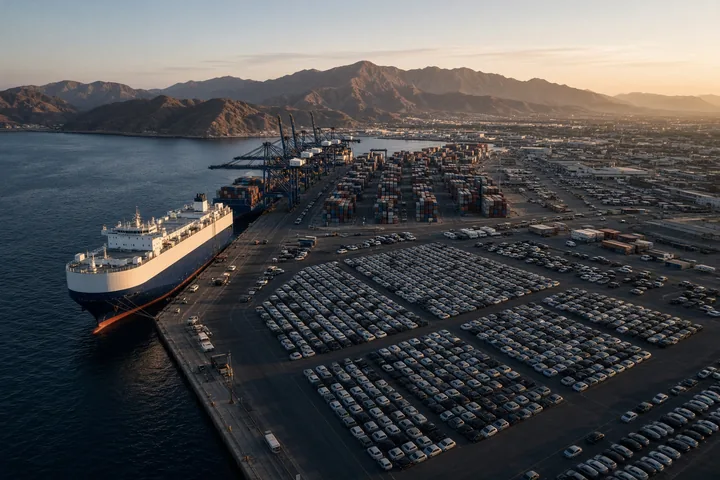
Oman’s vehicle market is modest: about 75,500 new vehicles in 2025. Its geography is not. The main commercial ports, Sohar on the Gulf of Oman and Duqm and Salalah on the Arabian Sea, lie outside the Strait of Hormuz, open to the Indian Ocean, East Africa, the Red Sea and the Indian subcontinent. For a brand building a presence across the Gulf and beyond, Oman can be a base for stock, parts and distribution, not only a market.
Why location mattered in 2026
- The strait. Since 28 February 2026, the war involving Iran has severely disrupted shipping through the Strait of Hormuz. A US–Iran memorandum to reopen it was signed in June, but carriers stayed cautious. On 12 October, Lloyd’s List Intelligence reported that September had seen the most transits (excluding Iranian-linked vessels) since the war began, while container traffic showed little improvement and the threat level was still rated severe.
- Oman’s ports took the traffic. In the first half of 2026, Port of Salalah’s revenue rose by about a fifth to RO51m on 15% higher volumes. Sohar handled 52m tonnes (up 52%) and 545,000 TEU (up 40%).
- Oman was not untouched. In March 2026, drones struck fuel tanks at Salalah port and an industrial area in Sohar, Duqm was also hit, and Maersk suspended Oman bookings except for Salalah for a period.
The lesson for a hub plan: location outside the strait is a real advantage, but the plan still needs security, insurance and alternative routings. The situation is changing, so check current conditions before committing.
The ports and zones
- Sohar Port and Freezone (Gulf of Oman). Already a vehicle logistics location: Saud Bahwan Group agreed in 2014 to set up a 40-hectare storage and distribution centre for Toyota and Lexus at Sohar, and Alfardan signed in 2022 for a stockyard and pre-delivery inspection site.
- Duqm Special Economic Zone (Arabian Sea). Large sites with port access. Home to Karwa Motors’ bus plant since 2021.
- Salalah Port and Free Zone (Arabian Sea). More than 1,000km from Hormuz. The port says it offers up to five days’ shorter transit between Asia and East Africa than other regional hubs. Trucking from Salalah to Jeddah takes four to five days.
- Khazaen Economic City (near Muscat). Includes two free zones established in 2023 and the Khazaen Dry Port, opened in December 2021 with capacity for 70,000 containers a year and one-stop customs clearance through Oman’s Bayan system.
Oman’s 2025 zones law (Royal Decree 38/2025) offers 100% foreign ownership and a ten-year income-tax exemption, which can be extended for up to two further periods for activities of a special nature.
What a hub can do
- Regional parts warehouse. Stock for the Omani network and neighbouring markets, with emergency supply to dealers. Parts availability is where new brands most often fail. See After-Sales First.
- Vehicle stockyard and pre-delivery inspection. Hold vehicles close to the market, carry out inspection and accessory fitting, and re-export as orders come in.
- Re-export. Serve the wider Gulf, East Africa and the Indian Ocean from one point of stock.
- A first step towards assembly. A hub can grow into kit assembly when volume justifies it. See Setting Up a Vehicle Assembly Plant.
What a hub cannot do
- Sell into Oman duty-free. Goods sold from a free zone into Oman pay customs duty as imports, so onshore sales normally go through an onshore distributor. This is from older published guidance; confirm it under the 2025 zones law. See Distributor, Joint Venture or Subsidiary?
- Make products local by default. Goods from a free zone are unlikely to count as GCC origin in Saudi Arabia. See GCC Rules of Origin.
- Pay for itself at low volume. Storage, handling and the extra port call must cost less than the savings in transit time, duty deferral and stock.
Planning questions
- Which markets will the hub serve, and with what: vehicles, parts or both?
- Is speed to the dealer the priority, or cost?
- Which port and zone fit the route: Sohar for the Gulf of Oman and the road link to the UAE, Salalah for East Africa and the Red Sea, Duqm or Khazaen for larger sites?
- How will transit, re-export and onshore sales be cleared through customs?
- What insurance cover and contingency routing apply if a sea lane closes?
This article is general information, not legal or customs advice.
How Lutis helps
We compare ports and zones for each brand’s routes, model hub costs against direct shipping to each market, and plan the warehouse, stockyard and customs flows with the distributor.
Sources (17)
- AGBI, Oman increases logistics revenues by offering Hormuz alternative (August 2026)
- The New Arab, Too early to resume Hormuz transits, shipping giants warn (16 June 2026)
- Lloyd’s List Intelligence, Strait of Hormuz brief, 12 October 2026
- Oman Observer, Sohar Port and Freezone advances industrial investment (19 August 2026)
- Al Jazeera, Two killed in Oman by drones, several also fired at Saudi Arabia (13 March 2026)
- AGBI, Imports rise at Oman port with Hormuz closure (March 2026)
- Oman Observer, Omani ports pitched as alternative hubs amid Hormuz crisis (9 March 2026)
- Port of Salalah, Growing East African market potential
- India Seatrade News, Port of Salalah introduces viable alternative to Red Sea route (10 May 2024)
- Times of Oman, Agreement signed to expand automotive cluster in Sohar (22 June 2022)
- Automotive Logistics, Sohar to become storage and distribution centre for Toyota and Lexus (June 2014)
- Oman Observer, Karwa commences operations and rolls out the first bus from its factory in Duqm (21 November 2021)
- AGBI, Oman to set up two new free zones in economic city (July 2023)
- Oman Observer, Khazaen Dry Port inaugurated in Barka (December 2021)
- Curtis, Free zones in Oman: an overview (July 2013)
- KPMG, Oman issues law for special economic zones and free zones (June 2025)
- BestSellingCarsBlog, Oman full year 2025 (February 2026)