
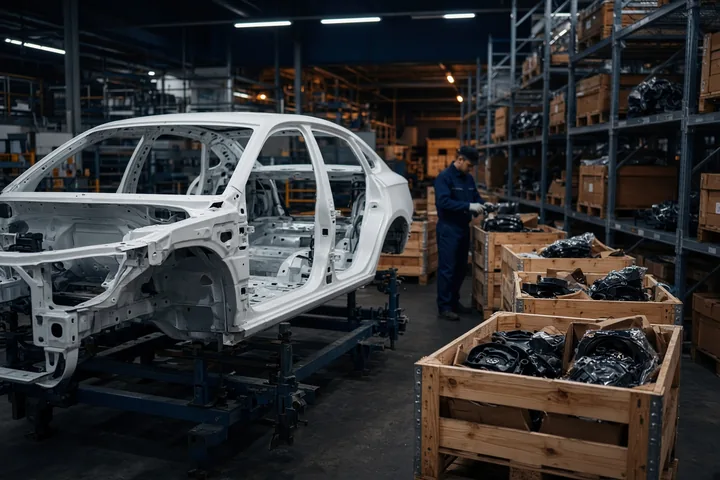
When a brand’s regional sales reach a certain level, local assembly comes onto the agenda. Sometimes a government raises it, sometimes a partner, sometimes a competitor’s plant announcement. The first real decision is how much of the vehicle to build locally. That choice drives the capital, the timeline, the workforce, the local content and, in the Gulf, whether the vehicle can count as locally made at all.
The terms
- SKD (semi-knocked-down). The vehicle arrives as major assemblies and is put together locally. Iveco describes an SKD kit as one split only into assemblies and main parts. Toyota South Africa’s chief executive has called it “light-touch assembly”.
- CKD (completely knocked-down). The vehicle arrives as loose parts. The plant welds the body, paints it and assembles the vehicle: in the same executive’s words, “the deep level of manufacturing processes including welding, painting and assembly”.
- MKD. Some suppliers use this label for kits between the two. There is no standard definition, so the contract should list exactly what arrives in the kit and what is done locally.
In practice this is a range, not two boxes. What matters is the process list (which of body welding, painting, stamping and final assembly happen locally) and the share of value that comes from local sources.
What recent plants have cost
Published figures for plants in Africa and the Middle East give an order of magnitude:
| Plant | Type | Announced investment | Capacity a year |
|---|---|---|---|
| Toyota, Ghana (2021) | SKD | USD7m | 1,300 |
| Hyundai, South Africa | SKD | Not stated | About 3,000 (estimated output), 30 permanent staff |
| Geely, Egypt (2025) | Assembly, two lines | Up to USD100m | Up to 10,000 |
| MG (Al Mansour with SAIC Motor), Egypt | Assembly | USD150m | 50,000 in phase one, 100,000 within five years |
| Hyundai with PIF, Saudi Arabia | CKD | About USD500m | 50,000 |
| Full-scale plant (unofficial estimate, Egypt) | Full manufacturing | USD1–2bn | 200,000 |
These are announced figures, not audited costs, and the scope differs from one project to the next: land, buildings, tooling and supplier parks are not counted the same way.
Scale matters as much as kit level. In 2019, Reuters reported that Toyota had proposed to Saudi Arabia only a plant of up to 10,000 vehicles a year using imported parts. According to a source, Toyota had found that costs would match other countries only with a 50% government incentive, and even then profitability was uncertain.
Policy is moving towards depth
- South Africa. On 15 October 2026, the trade minister, Parks Tau, announced that the government will not support new SKD facilities for light vehicles, will wind down existing operations that rely on imported bodies and kits, and will tighten the definition of CKD manufacturing. Medium and heavy commercial vehicles are excluded, and pickups remain under review. Toyota and BMW in South Africa had called for the change. Toyota South Africa’s chief executive argued in February that for every job created in SKD assembly, as many as eight are lost in the corresponding CKD operations.
- Egypt. The Automotive Industry Development Programme sets minimum volumes of more than 10,000 vehicles a year per manufacturer and 5,000 per model. Duties on imported cars are far higher than on assembly components.
- Algeria. Regulation sets a local-integration threshold of 30%.
- Saudi Arabia. Since 2021, packing and assembly alone do not give a product GCC origin for Saudi customs. We cover this in GCC Rules of Origin.
SKD can be a sensible starting point. A plan that stops at SKD is increasingly exposed: governments want welding, paint, local suppliers and jobs, and incentives follow depth.
A staged path: Fiat in Algeria
Stellantis’s Fiat plant at Tafraoui, near Oran, shows both the method and its limits:
- Speed. A framework agreement was signed in October 2022 and production started in December 2023, about 14 months later.
- The plan. At launch, the plant was to build 40,000 SKD vehicles in 2024, then move to CKD with local welding, painting and stamping, reaching 90,000 vehicles a year and more than 35% local integration by 2026.
- The outcome so far. It built 17,000 vehicles in 2024 and 33,000 in the first nine months of 2025, against a 2025 target of 60,000 that it was set to miss.
Staging works, but ramp-up is slower than launch plans. Build the cash-flow model on a realistic curve.
How to choose
- Volume. The examples above suggest SKD can start from around a thousand vehicles a year, while CKD investments are sized for tens of thousands. Use the volume you can actually sell, including exports, not the volume that makes the plant look good.
- Market access. Will the output need to count as local for duty or public tenders in other countries? If so, SKD, especially in a free zone, is unlikely to be enough for the GCC.
- Host-country requirements. Local content, jobs and timelines are often written into the incentive. Know them before you choose the kit level.
- Supplier base. CKD pays off when some parts (tyres, batteries, glass, seats, wiring, plastics) can be sourced locally or regionally. Otherwise the plant imports loose parts at a higher logistics cost.
- People. Welding, paint and maintenance need skilled staff, trained before the line starts. See Building a Local Technical Workforce.
- Room to grow. Design the site for the next stage: space for a body shop and paint shop, utilities sized for paint, and a layout that can add stations. The paint shop is usually the largest single item of capital and the longest to permit and commission.
How Lutis helps
We assess volume and market access, compare SKD and CKD scenarios on capital, unit cost and timeline, and plan a staged path from first assembly to deeper local content, including the site, the layout and the supplier plan. See Setting Up a Vehicle Assembly Plant for the full project sequence.
This article is general information, not investment or legal advice. Figures are as published by the sources below.
Sources (13)
- Iveco, What does CKD stand for?
- TimesLIVE, Halt partial assembly of light vehicles in SA, says Toyota boss (28 February 2026)
- Business Day (Reuters), South Africa to end support for semi-knocked-down car assembly (15 October 2026)
- Automotive Logistics, Toyota begins assembly from SKD imports in Ghana (2 July 2021)
- Foundry Planet, Geely debuts first car manufacturing plant in Africa (21 February 2025)
- Enterprise, Al Mansour Automotive breaks ground on MG manufacturing plant (4 November 2025)
- Korea Times, Hyundai and Saudi fund to build plant in Saudi Arabia (23 October 2023)
- Al Majalla, Egypt’s car assembly ambitions await investment (24 September 2025)
- Prothom Alo (Reuters), Toyota snub dents Saudi manufacturing drive (21 June 2019)
- Fast Company Middle East, Egypt targets 100,000 vehicles annually under automotive development programme (21 January 2026)
- MotorsActu, Stellantis: l’usine d’Oran en Algérie entre en production (13 December 2023)
- Automotive World, Iconic Fiat brand launches in Algeria (2023)
- TSA Algérie, Fiat Algérie loin de son objectif de produire 60 000 véhicules en 2025 (25 September 2025)