
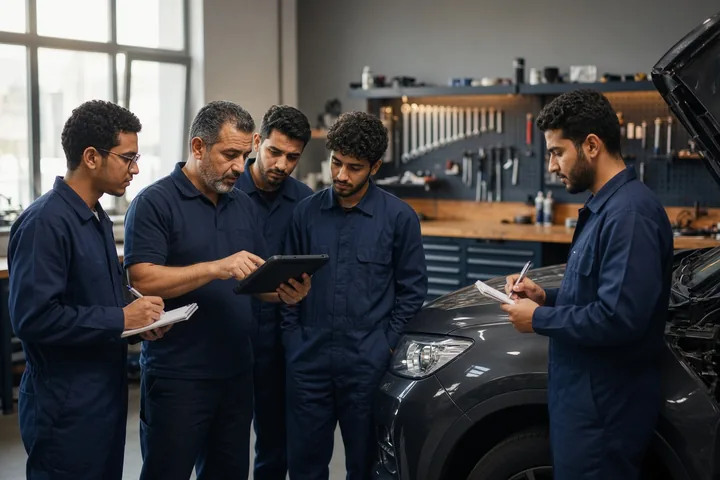
A vehicle brand can import its cars, its tools and its manuals. It cannot import its whole workforce. In Oman, staffing is shaped by Omanisation rules that reserve key automotive roles for Omani nationals, and by a technical skills gap that the industry itself describes as large. Brands that plan for both build a stable team. Brands that treat staffing as an afterthought find their launch held up by vacancies, or their service quality undermined by turnover.
The rules
Roles reserved for Omanis
Since September 2024, a Ministry of Labour decision (MD 501/2024) has reserved a further set of professions for Omani nationals. They include:
- new and used vehicle salespersons;
- new and used spare-parts salespersons;
- general-maintenance mechanics and electricians.
In other words, the people who sell your cars and parts must be Omani, as must general-maintenance mechanics and electricians. Check each workshop job title against the Ministry’s occupation list.
The Labour Law
The Labour Law (Royal Decree 53/2023) sets the framework:
- Hours and leave: a 40-hour working week, eight-hour days, and 30 days’ annual leave.
- Contracts: fixed-term contracts are capped at five years, and unfair dismissal attracts three to twelve months’ pay.
- Omanisation: employers must meet the Omanisation percentages set separately by the Ministry of Labour, and employers with 25 or more staff must employ and retain Omanis.
Foreign-owned companies
Under Ministerial Decision 411/2025, issued in October 2025, once a company set up under the Foreign Capital Investment Law has held its commercial registration for a year, it must appoint at least one Omani within three months of being notified by the Ministry of Labour. Companies that do not comply face a ban under the Ministry’s mechanism.
Free and economic zones
Zones apply their own Omanisation levels. Al Mazunah Free Zone, for example, states 20%. Older published figures for Sohar, Salalah and Duqm range from 15% to 25%, but zone rules are being updated under the 2025 zones law. Confirm the current level with the zone authority before planning headcount.
The skills gap
In 2023, the dean of the National College of Automotive Technology, which then had capacity for about 400 students and trainees a year, cited a shortage of more than 50,000 workers in Oman’s automotive sector. Whatever the exact figure, the direction is clear: experienced, brand-trained technicians are scarce, and good ones are hired away quickly.
Where to find and train people
- The National College of Automotive Technology (NCAT): automotive technician training with industry partners.
- Ministry of Labour vocational colleges: seven branches running courses in light-vehicle repair, body and paint, and operational mechanics.
- Your own academy: for a brand planning a national network or a plant, a structured training centre is usually cheaper than hiring experienced staff in a tight market.
Staffing a dealer network
- Map every role against Omanisation rules first. Sales, parts sales and general maintenance roles must be filled by Omanis; plan recruitment accordingly.
- Recruit for attitude and train for skill. Graduate technicians from NCAT and the vocational colleges can be brought to brand certification through a defined path.
- Set certification levels per role, such as service adviser, technician, senior technician and master technician, with pay linked to each level.
- Plan for retention. Career paths, certification-linked pay and recognition cost less than replacing trained staff.
- Start early. Recruitment and basic training should begin months before the showroom opens, not after.
Staffing an assembly plant
A plant needs a broader mix: production operators, quality inspectors, maintenance technicians for robots and paint systems, logistics staff and engineers. Practical steps:
- Partner with colleges before construction finishes, so the first intake is trained when the line is ready.
- Use the brand’s experienced staff for start-up, with a planned handover to local teams. Set the localisation targets in the investment plan from the start.
- Write training materials in Arabic and English, and build skills matrices for each station.
- Check the zone’s Omanisation level if the plant is in a free or economic zone.
See Setting Up a Vehicle Assembly Plant for how staffing fits the wider plant timeline.
This article is general information, not legal advice. Omanisation and labour rules change often and should be confirmed with the Ministry of Labour or Omani counsel.
How Lutis helps
We build workforce plans that meet Omanisation rules, design certification paths and training programmes with local colleges, and plan start-up staffing for dealer networks and assembly plants, so that people are ready when the facilities are.
Sources (8)
- Times of Oman, Ministry of Labour lists 32 new professions to be reserved for Omanis (6 September 2024)
- Clyde & Co, The new Omani Labour Law (August 2023)
- Chambers and Partners (Said Al Shahry & Partners), Doing Business in 2026: Oman (July 2026)
- Al Tamimi & Company, New Omanisation mechanism for businesses (March 2026)
- OPAZ, Al Mazunah Free Zone
- CMS, Guide to Oman’s economic and free zones (October 2019)
- Times of Oman, Training the next-generation workforce for the automobile industry in Oman (25 September 2023)
- Oman Observer, Register for vocational courses (16 September 2026)