
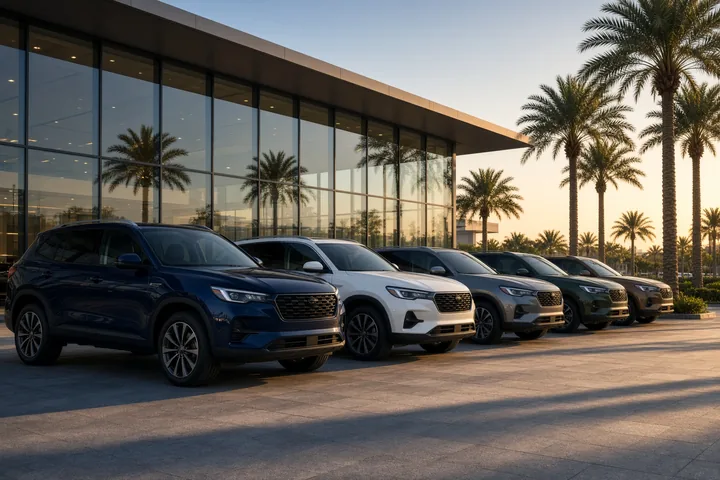
In 2019, Chinese brands were a rounding error in Gulf new-vehicle sales. Roland Berger put their GCC share at about 2% that year and estimated 15% for 2025. GlobalData puts it at 16% in 2024 and over 20% in 2025, and forecasts around 30% by 2030. Japanese brands still hold more than half the market.
For a brand arriving now, the question is no longer whether Gulf buyers will consider a Chinese vehicle. It is why they should choose yours, and whether they will come back for a second one.
Oman in numbers
- 2025. The market grew 14.5% to 75,549 new vehicles. Toyota held 48.4%. Jetour rose 171% to third place among brands. MG, which reached second place in 2023, fell 20.7%.
- First half of 2026. The market fell 15.2% to 30,870. Toyota’s share dropped to 42.6%. Jetour rose to second with 8.3%, and Changan was in the top five.
- What buyers choose. The five best-selling models in 2025 were all pickups or SUVs: Toyota Hilux, Land Cruiser, Land Cruiser Pickup, Jetour T2 and Isuzu D-Max.
Being Chinese is not the story; execution is. In the same year, one Chinese brand nearly tripled its sales and another lost a fifth.
What buyers worry about
- Resale value. UAE motoring site ZigWheels estimates three-year retained values for Chinese models at roughly 50–60%, against 65–75% for Japanese models. In the UAE used-car market, AutoData reported that the average time to sell rose from 14 to 42 days between April and July 2025, partly because of a wave of used Chinese vehicles.
- Parts and service. Roland Berger names after-sales service, including parts availability, as an area where Chinese brands must invest to succeed in the GCC.
- Durability. Buyers ask whether a vehicle will cope with summer heat, dust and long highway distances.
- Staying power. Buyers want to know that the brand and its dealer will still be there when the warranty runs out.
How leading brands have responded
- Long warranties. Jetour launched in Oman in 2022 with a 10-year or 1,000,000km engine warranty. Changan launched in Oman in 2020 with 5 years or 150,000km. In the UAE, Chery’s Omoda C5 carries 7 years or 150,000km, while MG, Geely, Changan and GAC offer 3 to 5 years.
- Certified pre-owned. In May 2026, Elite Group Holding launched Jetour Trusted Pre-Owned, a certified pre-owned business for Jetour in the UAE: a direct answer to the resale question.
- Established local partners. Several Chinese brands in Oman are represented by long-established Omani groups. Chery, for example, joined Saud Bahwan Group in 2023, and Geely is represented by Towell Auto Centre.
What a new entrant needs to get right
- Choose the partner for after-sales, not showrooms. The workshop decides whether the customer buys a second time. See After-Sales First.
- Put parts on the shelf before the vehicle is in the showroom. Agree fill-rate targets and decide where regional stock will sit. See Oman as a Regional Hub.
- Manage residual values deliberately. Control rental and fleet volumes, keep pricing consistent rather than discounting in cycles, and plan certified pre-owned and buy-back programmes from launch.
- Offer a warranty you can honour. A long headline warranty builds trust only if claims are approved quickly and the network handles them well. Oman’s Consumer Protection Law adds its own duties, including a free replacement vehicle when a repair takes more than 15 days.
- Specify for the Gulf. Cooling, filtration and air conditioning for local conditions, and certification to Gulf standards before the first order. See Before the First Sale.
- Show commitment. A regional parts centre, a training academy or, in time, local assembly tells buyers and governments that the brand intends to stay. See Setting Up a Vehicle Assembly Plant.
How Lutis helps
We help vehicle brands entering Oman choose and assess partners, plan after-sales and parts operations, design warranty, residual-value and pre-owned programmes, and build the case for longer-term investment, from a regional hub to local assembly.
Sources (13)
- Roland Berger, Chinese automotive OEMs: winning formula for success in the GCC (6 November 2024)
- MEED Mashreq Industry Insight, Beyond EVs: how geopolitics and technology are reshaping GCC automotive (3 August 2026)
- FOURIN, Chinese car brands in GCC: sales offensive intensifies as Japanese share declines (6 July 2026)
- BestSellingCarsBlog, Oman full year 2025 (February 2026) and Oman H1 2026 (August 2026)
- ZigWheels UAE, Chinese car resale values in the UAE (17 August 2026)
- Communicate (AutoData Middle East), H1 2025 used-car market report for the UAE and KSA (1 October 2025)
- Black & White Oman, Jetour launch in Oman (21 December 2022)
- Black & White Oman, Arabian Gulf Automobiles and Equipment launches Changan in Oman (2 December 2020)
- YallaMotor, Chinese car warranty guide (17 August 2026)
- Khaleej Times, Elite Group Holding debuts Jetour Trusted Pre-Owned in UAE (May 2026)
- MarkLines, Chery and Saud Bahwan Group in Oman (21 December 2023)
- Black & White Oman, Geely and Towell Auto Centre in Oman (22 July 2024)
- Times of Oman, Beyond the sale: warranty obligations under Oman’s Consumer Protection Law (20 December 2025)